# What is SegWit (Segregated Witness)?
> SegWit, activated in 2017, revolutionized Bitcoin by fixing transaction malleability, enhancing scalability, and enabling the Lightning Network.
- Source: https://getbittr.com/bittr-academy/bitcoin-inside/what-is-segwit-segregated-witness
- Language: en
- Last updated: 2025-06-25
Segregated Witness (SegWit) is one of the most impactful upgrades in Bitcoin’s history. Activated in **2017** , SegWit changed how Bitcoin transactions are structured, primarily by **separating signature data from transaction data** . This solved a critical issue known as **transaction malleability** and **paved the way for the Lightning Network** and other future innovations. SegWit also increased block size capacity
Despite its benefits, SegWit was highly **controversial.**
This article explains how SegWit works, its technical impact, and the key lessons learned from its activation.
A SegWit address starts with either “3…” or with “bc1…..”. It was activated in Bitcoin Core in 2017. Today over 90% of transactions are using SegWit.
## **Fixing Malleability**
One of SegWit’s most important contributions was fixing **transaction malleability -** a vulnerability that allowed transaction IDs ( **txids** ) to be changed before confirmation.
### **How it worked before SegWit**
A Bitcoin transaction contains several components, including:
- **Inputs** (where the bitcoin is coming from)
- **Outputs** (where the bitcoin is being sent)
- **Signatures** (proof that the sender authorized the transaction)
Before SegWit, **signatures were included in the transaction data** , which meant that an attacker could **alter** the signature data slightly without changing the transaction’s validity. This changed the **txid** (transaction identifier), which could cause **problems for protocols that relied on unconfirmed transactions—like the Lightning Network** .
### **How SegWit solved the Problem**
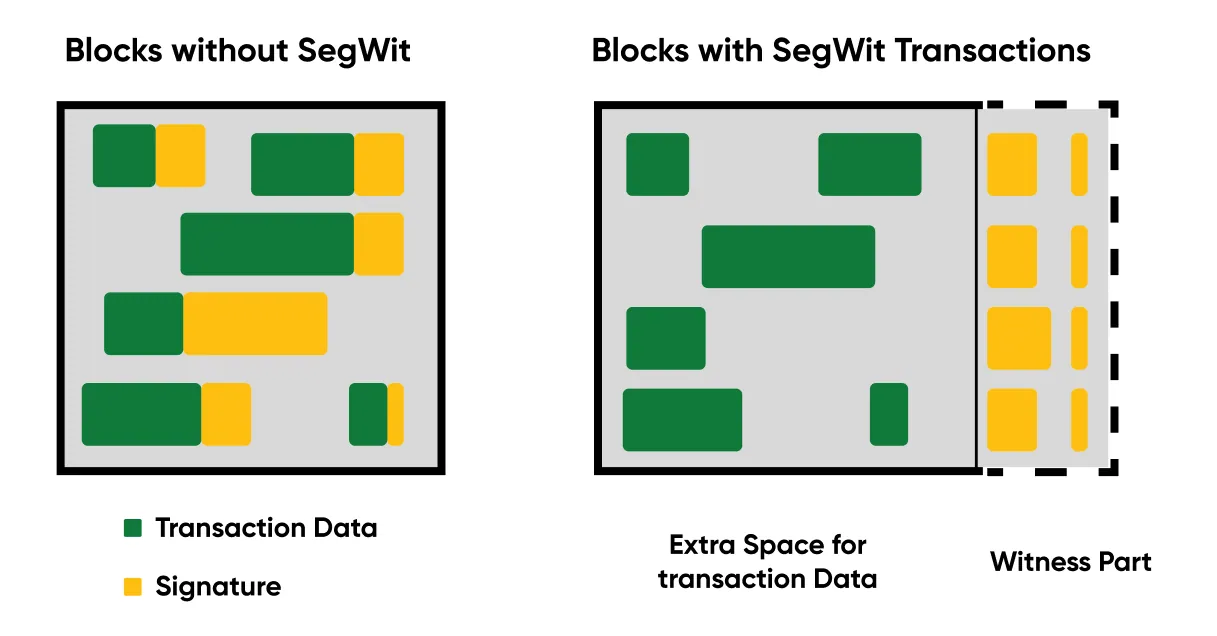
SegWit **separated signature data from transaction data** , moving it to a new section called the **Witness** . Since the **txid is now calculated without the signature data** , it can no longer be altered after the transaction is signed.
✅ **No more txid manipulation**
✅ **Safer unconfirmed transactions**
✅ **Enables the Lightning Network**
## **SegWit enables the Lightning Network**
The **Lightning Network** is a second-layer protocol that enables **instant, cheap, and scalable Bitcoin transactions** . However, before SegWit, Lightning was **impractical** due to the **transaction malleability issue** .
Since Lightning relies on **unconfirmed, pre-signed transactions** , malleability attacks could **disrupt payment channels and cause potential fund loss** . By making txids **immutable** , SegWit provided the **foundation for Lightning payments** .
Without SegWit, **Bitcoin’s ability to scale efficiently would be severely limited** .
## **How did SegWit Increase the Block Size?**
Although SegWit was not explicitly designed as a **block size increase** , it effectively **increased transaction throughput** by introducing **block weight** instead of block size.
## **What is Block Weight?**
Prior to SegWit, Bitcoin blocks were limited to **1MB in size (Around 1,650 transactions)** . SegWit introduced **block weight** , a new method of measuring block size, that allows around 2,700 transactions per block:
- **Non-witness data (transaction data)** → Counts **4 weight units per byte**
- **Witness data (signatures, scripts)** → Counts **1 weight unit per byte**
The maximum block weight is **4 million weight units** , meaning blocks can now fit up to **4MB worth of transactions** , though most remain between **1.5MB and 2MB** on average.
This also lowered the transaction fees through less competition for block space
This upgrade allowed **Bitcoin to scale without requiring a hard fork** .
## **SegWit’s New Script Types**
SegWit introduced **two new ways** to send and receive bitcoin:
1. **Pay-to-Witness-Public-Key-Hash (P2WPKH)**
- Similar to the legacy **Pay-to-Public-Key-Hash (P2PKH)** format
- Signature data is moved to the **Witness**
- More efficient and cheaper than legacy transactions
1. **Pay-to-Witness-Script-Hash (P2WSH)**
- A SegWit version of **Pay-to-Script-Hash (P2SH)**
- Used for **multisig and complex scripts**
- Reduces blockchain bloat by keeping script data in the Witness
Both formats help **reduce fees and increase transaction efficiency** .
## **Whati is Bech32?**
SegWit also introduced **Bech32** , a new address format that improves **readability and efficiency** .
### **Bech32 vs. Legacy Addresses**
- **Bech32 addresses start with "bc1"**
- **They are more space-efficient** → Lower fees
- **They have built-in error detection**
- **They are fully SegWit-compatible**
**Not all wallets and exchanges have adopted Bech32** , but its advantages make it the preferred format for **optimal fee savings and network efficiency** .
## **SegWit History and Activation**
SegWit was first proposed in **2015** by **Pieter Wuille** , but its **activation was highly controversial** .
**Miners and some businesses opposed it** , fearing a loss of influence. A group of large Bitcoin companies pushed for a **hard fork (SegWit2x)** , which would have increased the block size limit to **2MB,** but this was widely rejected by node operators.
SegWit was activated through **BIP 148** , a User Activated Soft Fork ( **UASF** ) in **2017** .
### **Why did Node Operators oppose SegWit2x?**
- A **hard fork** would have split Bitcoin, creating **uncertainty and division** .
- Larger blocks would **increase centralization** , as running a full node would become **more expensive and not affordable for everyone anymore.**
- The **process was seen as an attempted corporate takeover of Bitcoin** .
Ultimately, **Bitcoin remained decentralized** , and SegWit was activated **without a hard fork** .
### FAQ
How do different Bitcoin address types look like?
- **Legacy addresses** start with **“1”** (P2PKH)
- **Wrapped SegWit addresses** start with **“3”** (P2SH-P2WPKH)
- **Native SegWit addresses** start with **“bc1”** (P2WPKH, Bech32)
If your Bitcoin address **starts with “3” or “bc1”** , you are **using SegWit** .
Can I Send BTC to a SegWit Address?
Yes. **Legacy, SegWit, and Native SegWit addresses are fully compatible** with each other. You can send BTC **from any address type to any other** without issues.
What’s the Difference between SegWit and Native SegWit?
**SegWit (P2SH-P2WPKH, “3” address):**
- More widely supported across **exchanges and wallets**
- **Lower fees** than legacy, but higher than Bech32
**Native SegWit (Bech32, “bc1” address):**
- **Lowest possible fees**
- **Most efficient use of block space**
- Less supported by some older wallets
If you **want maximum compatibility** , use **SegWit (P2SH)** .
If you **prioritize the lowest fees** , use **Bech32 (Native SegWit)** .
## **Takeaways from SegWit**
The battle over SegWit proved that **Bitcoin is not controlled by anyone - not miners, developers, or corporations** .
- Bitcoin is dezentralized → The community rejected SegWit2x and kept Bitcoin resistant to corporate influence.
- Hard Forks are not acceptable in Bitcoin → SegWit activated without disrupting Bitcoin.
- **SegWit paved the way for future upgrades** → Lightning Network, Taproot, and improved scalability.
## **The Impact of SegWit**
- **Lower transaction fees**
- **Increased transaction throughput**
- **Higher miner revenue due to more transactions per block**
SegWit is now **used in nearly all Bitcoin transactions** and has proven to be a **massive success** in improving **Bitcoin’s scalability and efficiency** .
## Final Thoughts
- **SegWit fixed transaction malleability and enabled the Lightning Network**
- **It increased Bitcoin’s effective block size through a soft fork**
- **It introduced new transaction types and Bech32 addresses**